Is the world getting darker, or brighter?
◇ Sri Yukteswar ji's cycle of the ages: 12,000 years down, 12,000 up
◇ By his count, Kali ended in 1699.
By Swami Sri Yukteswar Giri's reckoning, humanity is in ascending Dwapara Yuga, the age of energy. This is its year 327 (2026-27 in today's calendar), and we are climbing.
◇ In 1894 he wrote: “the dark age of Kali yuga having long passed away”
The sky is a clock.
Every year the Sun walks the same circle through the stars. One point on that circle marks where spring begins: the equinox.
That point does not stay put. It slides slowly backward past the stars, about one degree every 72 years. Astronomers measure it every year. Scroll, and watch fourteen centuries pass.
Earth wobbles like a lattoo.
Earth spins on a tilted axis. The pull of the Moon and the Sun makes that axis wobble slowly, like a spinning top. One wobble takes about 26,000 years.
That wobble, the precession of the equinoxes, is what moves the equinox. It even changes the pole star: Thuban in the age of the pyramids, Polaris (Dhruv) today, Vega in about 12,000 years.
You can see it in a festival.
Makar Sankranti once fell on the shortest day of the year. Today it comes about 24 days later, and it slips about one more day every 73 years.
Same drift, same cause. This proves the sky moves; it does not, on its own, prove any age.
What the clock means.
In 1894, in Serampore, Bengal, Swami Sri Yukteswar Giri wrote The Holy Science. He taught that as this hand moves, humanity's understanding rises and falls.
The full turn takes 24,000 years: 12,000 years down, 12,000 years up. Near the top, people understand everything, even Spirit. Near the bottom, only the solid, material world.
In the picture, the white hand is the book's sky clock: lowest in 499, moving 54 arcseconds a year (the measured sky moves about 50). The gold bands are his reading of it. More light means more understanding. The small white point at the centre is only where the hand turns; the book places the grand centre toward the top of the circle, not at its middle.
His diagram, made clear.
The same circle as at the top of the page, now with every age named.
The Holy Science draws the whole cycle as one circle, and it reads like a clock. The top is the point nearest the grand centre; the bottom, around the year 499, is the farthest. From the top the ages run down the right side, then climb back up the left. Brighter means more understanding.
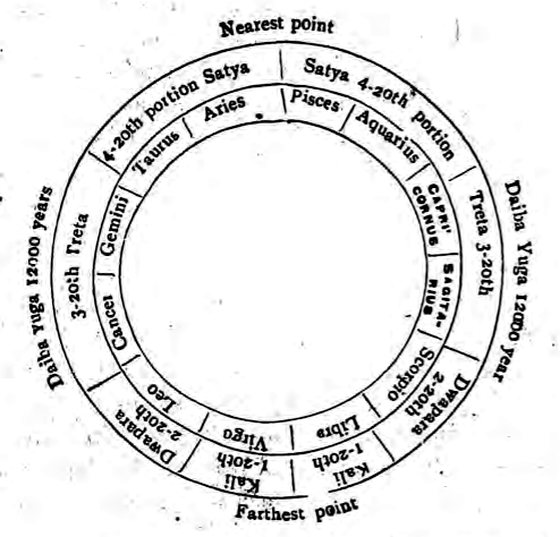
Drawn for this page from the book's own diagram: the same ages, proportions and twelve signs. The colours, the hand, the arrows and the gold mark are ours; the book labels each half Daiba Yuga, 12,000 years. BC dates follow the book's arithmetic, one year less than the usual count: its 3101 BC is the panchang's 3102 BC.
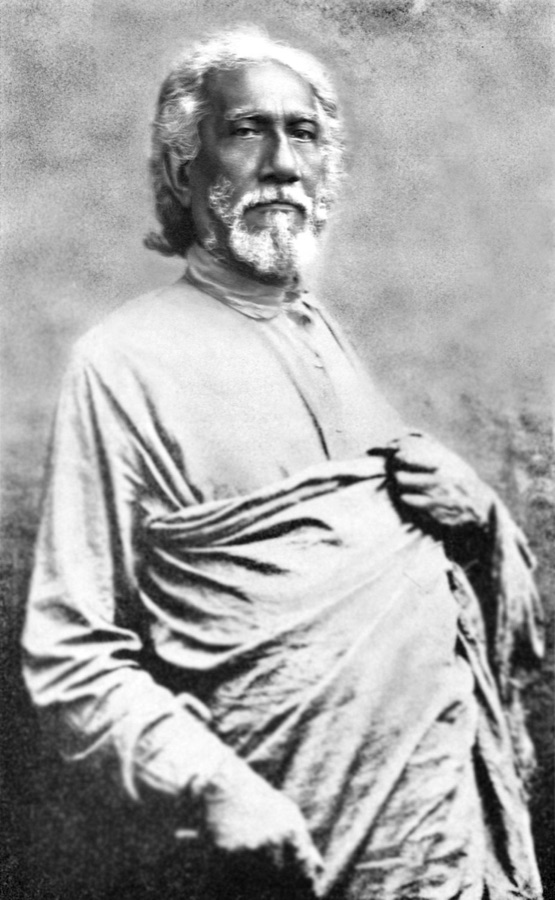
Swami Sri Yukteswar Giri
Born Priya Nath Karar in Serampore, Bengal, he became a Kriya yogi, a scholar of the Bhagavad Gita and the Upanishads, and an astronomer and jyotishi. He was a disciple of Lahiri Mahasaya, and the guru of Paramahansa Yogananda, who called him a Jnanavatar, an incarnation of wisdom.
In 1894, at the Kumbha Mela in Allahabad, Mahavatar Babaji asked him to write a book showing the harmony of the Hindu scriptures and the Bible. He finished it that same year: Kaivalya Darsanam, The Holy Science. Its introduction is the source of everything on this site.
With gratitude and respect. This site explains his teaching on the ages; for his spiritual teachings and Kriya Yoga, please turn to the lineage organisations.
The long night, and the dawn.
From a peak around 11,501 BC, the hand fell through four ages, Satya, Treta, Dwapara and Kali, to the lowest point around the year 499. Then it turned, and began to climb.
Keep scrolling to run the clock.
Four steps down. Four steps up.
Kali lasts 1,200 years, Dwapara 2,400, Treta 3,600, Satya 4,800. Each begins and ends with a gentle transition, a sandhi. We climbed off the bottom step around 1700, and stepped fully onto the second around 1900.
Four ages of understanding.
In his teaching, each age lights one more lamp of understanding. It describes humanity's broad capacity, not any person's worth.
Kali
The age of matter. People grasp only the outer, solid world.
Dwapara
The age of energy. People come to understand the finer forces, "the fine matters or electricities and their attributes".
Treta
The age of deeper forces, when the mind can grasp "the magnetism the source of these electricities on which this creation depends".
Satya
The age of truth. Full understanding, "even God the Spirit beyond this visible world".
The age of energy.
Almost every founding discovery about electricity and magnetism came after 1600. In 1894 he wrote that after 1899, when Dwapara proper begins, "the knowledge of the aforesaid fine matters", the electrical forces then in use but not understood, "will begin to develop". Within eleven years came the electron, the quantum and E = mc².
A dated comparison, not a proof. Earlier brilliance was real: Aryabhata, the Islamic Golden Age, Shen Kuo's compass in 1088. The teaching speaks of humanity's broad understanding.
Power is not yet wisdom.
The same age that lit our cities also built the atomic bomb. In his teaching, understanding in Dwapara is only half grown: two lamps of four. What we do with it is still ours to choose.
By his count. Dwapara's opening transition ended around 1899. Its main period runs to 3899, and its closing transition to 4099. Then, he taught, comes Treta.
Turn the clock
Your birth year
Why most calendars say Kali Yuga.
Most panchangs count a Kali Yuga of 432,000 years that began in 3102 BC. Sri Yukteswar ji called the 432,000 a mistake, but kept the panchang's running year count (5127 years complete in 2026-27) and explained what it has really been counting.
In his reckoning, the panchang's count began at the start of descending Dwapara and was never reset. Since then: 2,400 years of descending Dwapara, then 1,200 of descending Kali, then 1,200 of ascending Kali. Subtract those 4,800 years, and what remains is ascending Dwapara.
Check your own panchang
The Puranas count yugas in divine years (one equals 360 human years). Manu's verses on the ages speak of plain years. Paramahansa Yogananda placed this 24,000-year cycle within the scriptures' much longer one. Both reckonings can stand side by side.
Kali Yuga, or Dwapara? Check it yourself.
Most of us grew up hearing that this is Kali Yuga. So it is fair to ask: why does this page say Dwapara, and what is the guarantee? No one can guarantee either answer. But every step of this one can be checked, and you can check it yourself.
One calendar, two readings
| The traditional reading (the Puranas) | Sri Yukteswar ji's reading |
|---|---|
| How long is an age? | |
| Kali Yuga lasts 432,000 years: 1,200 divine years, each of 360 human years. | Kali lasts 1,200 years. He read Manu's verses as plain years, and taught that the ages run 12,000 years down, then 12,000 up. |
| What does the panchang's Kali 5127 (2026-27) count? | |
| The years since Kali Yuga began, in 3102 BC. | The years since descending Dwapara began, in that same 3102 BC. The count was never reset. |
| Where are we now, in 2026-27? | |
| Kali Yuga, with 5127 years complete and 426,873 still to come. | Ascending Dwapara, year 327. |
| Which way are we going? | |
| Further down, until this long cycle ends. | Up. Treta begins in 4099. |
Check it in four steps
- 1◎ MeasuredThe sky really keeps a slow clock.
The point where spring begins slides backward through the stars, about one degree every 72 years: one full turn in about 25,800 years. The book's 24,000 comes from the traditional Indian rate of 54 arcseconds a year, not from measurement.
How to check: Makar Sankranti once fell on the shortest day of the year, around 21 December. Your calendar now puts it on 14 or 15 January. That gap comes from this slide.
- 2◇ Sri Yukteswar ji's teachingManu's ages: plain years, or divine years?
Manu's verses (1.69 to 1.71) give Satya 4,800 years, Treta 3,600, Dwapara 2,400 and Kali 1,200: twelve thousand in all, which he calls an age of the gods. Two verses earlier (1.67) he says one of our years is a single day and night of the gods. So the Puranas, the Surya Siddhanta and Manu's commentators such as Kulluka Bhatta read these as divine years of 360 human years each, which makes Kali 432,000 years. Sri Yukteswar ji read age of the gods as the name of the 12,000-year span, not as a multiplier.
How to check: read Manusmriti 1.67 to 1.71 in any translation. This is the one step where you have to choose.
- 3◇ Sri Yukteswar ji's teachingDo the subtraction on your own panchang.
Your panchang prints the Kali year: 5127 this year. Read as plain years, that count began with descending Dwapara, which lasted 2,400 years, then descending Kali, 1,200, then ascending Kali, 1,200. Take those 4,800 away and 327 is left: ascending Dwapara, year 327, which is 2026-27.
How to check: type your panchang's number into the tool above.
- 4◎ Dated historySee if history moved the way he said.
In 1894 he wrote that after 1899, when Dwapara proper begins, "the knowledge of the aforesaid fine matters", the electrical forces then in use but not understood, "will begin to develop". The quantum came in 1900 and E = mc² in 1905, with the electron just before, in 1897.
How to check: those dates are in any history of physics.
The conclusion
Steps 1, 3 and 4 you can check with your own eyes, your own calendar and any history book. Only step 2 asks you to choose. Read Manu's ages as divine years, as the Puranas do, and 2026-27 falls in Kali Yuga, with 5127 years complete; this page cannot prove that reading wrong. Read them as plain years, as Sri Yukteswar ji did, and your own panchang's number lands in ascending Dwapara, year 327, which is 2026-27.
Why plain years? Because then the cycle sits close to a clock the sky really keeps (step 1), and the age of electricity arrived when he said it would (step 4). That is his case. Weigh it for yourself.
Watch: The Sky Clock
The whole idea in one minute. Choose your language.
Made in Dwapara year 327 (2026-27).
About a minute. The sky, the clock and every number are drawn from this site's own 3D model; the cinematic scenes are artistic depictions made with AI.
Questions people ask.
Is this proven by science?
No, and we do not claim it. Astronomy measures the moving sky. That this motion tracks human understanding is Sri Yukteswar ji's teaching. Every section of this page is labelled so you can see which is which.
If astrologers say it is Kali Yuga, how are their charts still accurate?
Because a chart never uses the name of the age. A birth chart is built from where the Sun, Moon and planets stand among the stars at that moment, and that comes from astronomy, whatever the age is called. The panchang's Kali year is a running count, like a calendar number. In fact every sidereal chart corrects for the same slow drift this page is about: the ayanamsa, about 24 degrees today. Sri Yukteswar ji was a jyotishi himself; he did not question the charts, only what that count means. Whether a chart's predictions come true is a matter of faith, not of the yuga.
Does Kali Yuga end in 2025, 2026 or 2032?
Not in this teaching. By Sri Yukteswar ji's count, Kali Yuga is already behind us: rising Kali ran from 499 to 1699, and Dwapara's opening transition ran to 1899. Dates like 2025 or 2032 come from other readings, not from The Holy Science. The Puranic count says the opposite: Kali Yuga lasts 432,000 years and has more than 400,000 still to run.
What comes after Kali Yuga, and which yuga is 2030?
In his teaching the ages climb back in reverse order, so after Kali comes rising Dwapara, not Satya. Rising Dwapara runs from 1699 to 4099, which makes 2030 Dwapara year 331 by his count. Treta follows from 4099 to 7699, and Satya from 7699. In the Puranic order, Satya comes only after Kali's full 432,000 years.
How many years is one yuga?
It depends whose count you use. The Puranas give Kali 432,000 years, Dwapara 864,000, Treta 1,296,000 and Satya 1,728,000: 4,320,000 in all. The Holy Science reads Manu's verses as plain years: Kali 1,200, Dwapara 2,400, Treta 3,600 and Satya 4,800, transitions included. That is 12,000 years one way and 24,000 for the full fall and rise.
Isn't one wobble about 25,800 years, not 24,000?
Yes. The book used the traditional Indian rate of 54 arcseconds a year, which gives exactly 24,000. Today's measured rate gives about 25,800. Even at the measured rate, the equinox has passed the line the book draws for the end of Kali.
Why 327 and not 326?
The book's arithmetic is the panchang's Kali year minus 4,800. In 1894 that gave 4,994 minus 4,800, which is 194, the number the book itself prints. This year's panchang (2026-27) says Kali 5127, so 327. If yours prints 5128, the year under way, subtract 4,801.
If we are rising, why the wars and the atomic bomb?
Dwapara is the age of understanding energy, not of goodness. In his teaching, understanding in Dwapara is only half grown. Power is not yet wisdom.
Do the scriptures say we are in Dwapara?
No. The Puranas count Kali Yuga as 432,000 years. The rising order is Sri Yukteswar ji's own teaching, a reading of Manu's older verses, which count the ages in plain years. The nearest Indian precedents are the Jain rising and falling half-cycles, and Aryabhata's division of the yuga into rising and falling halves.
Is the "twin star" real?
The book says the Sun circles a "dual" star. Telescopes have not found one, and the pull of the Moon and Sun fully explains Earth's wobble. We present it as the image he used, not as astronomy.
Wasn't the year 499 Aryabhata's time?
Yes. By his own verse, Aryabhata was 23 in 499. The low point describes humanity's broad understanding, not its geniuses.